Ancient Granite Quarry in Aswan, Egypt

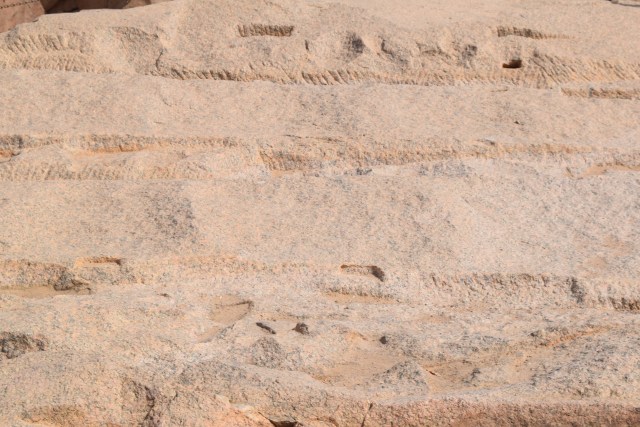
One of the first things we visited when we arrived in Aswan was the northern quarry, which contains an unfinished obelisk. Most of the granite that was used in ancient Egypt was mined from the quarries of Aswan and carried up the Nile on boats. It must have been extremely hard work to mine granite by chipping away at it with other stones. The day that we arrived in Aswan it was 114 degrees Fahrenheit (about 44.5 degrees Celsius), which made the thought of conditions that the ancient workers even more oppressive.

DSC_5908
Looking Down at the Quarry and the Unfinished Obelisk
DSC_5919
Marks in the Granite
DSC_5895
The Top of the Unfinished Obelisk

The giant obelisk that remains partially excavated from the granite quarry is quite impressive to see. It was commissioned by the famous female pharaoh, Hatshepsut and would have likely ended up with the other obelisks in the Karnak Temple in Luxor. Had the workers completed the obelisk, it would have been the largest ever created, but a crack in the stone stopped work on the obelisk. It has remained frozen in time as the workers have left it for thousands of years. In the time of Hatshepsut, obelisks were meant to represent the rays of sun, a way for the god Amun-Ra (Sun God) to descent to earth. It was important that obelisks be constructed out of a single stone without any cracks, otherwise the gods wouldn’t be able to travel through them.

DSC_5164
One of the Finished Obelisks in the Karnak Temple
DSC_5916
The Narrow Space for Workers
DSC_5891
Walking Through the Quarry

Probably more interesting than the reason for the creation of the obelisks is the transportation and actual placing of the obelisks in their final positions. After carefully chiseling the obelisks from the hard granite, they would raise them up and transfer them to a ship where they would be transported, standing erect, up the Nile. It must have been an unbelievable sight to the farmers living along the Nile when the ship with its cargo reaching towards the sky when sailing past them. Then, once reaching their location, such as the Karnak Temple, they would have to be transported across ground to their final location, all without breaking these huge structures. It is truly a task to be admired, even in today’s modern world.

DSC_5897
Close Up of the Cracked Obelisk
DSC_5900
People in the Background Provide Scale to the Obelisk
DSC_5901
Ancient Quarry Next to City Buildings

Visiting the ancient quarry with its unfinished obelisk is truly fascinating and should definitely be on your itinerary when visiting Aswan. There is very little shade at the quarry site, so be prepared for the heat and bring plenty of water.  Walking around the quarry will only take about an hour or two, so you should have another destination mapped out for before or after.  During our trip, after leaving the quarry, we continued onto the island of Philae to see the Temple of Isis.

Hatshepsut Temple and the Colossi of Memnon

There are so many fascinating sights to see when visiting Luxor, Egypt that you could easily spend a week or more in the area. Although the Valley of the Kings and Karnak Temple are absolute must-see’s, the Mortuary Temple of Hatshepsut and the Colossi of Memnon should also be on your list. They are both located on the west bank of the Nile outside of Luxor and we visited them after spending several hours in the Valley of the Kings. As with a lot of the things that you will find in Egypt, these are both amazing partially due to their sheer size.

DSC_5373
Statues Outside of the Hatshepsut Temple’s Main Building
DSC_5398
Both of the Colossi of Memnon Statues
DSC_5378
Hieroglyphs Inside of the Temple
DSC_5371
Head of a Collapsed Statue

The Hatshepsut Temple is dedicated to both the god Amun as well as Hatshepsut, who was the greatest female pharaoh of ancient Egypt. Her reign begin in 1507 BCE and lasted for about 50 years. Her influence can be found throughout the temples of Egypt and she was responsible for the creation of the largest obelisks in Karnak Temple. The temple itself is considered one of the greatest architectural achievements of ancient Egypt with a style that resembles the classic Greek architecture that would follow about a thousand years later. It took 15 years to complete the construction of the temple and it is quite impressive, especially with the backdrop of the mountains behind it. Djeser Djeseru (holy of holiest) is the name of the main building and is also sometimes used to refer to the entire temple.

DSC_5351
Very Impressive
IMG_7842
Close-Up of One of the Statues
IMG_7836
Many Steps to Climb
DSC_5374
Inside the Temple Grounds

The Colossi of Memnon are two enormous statues representing Amenhotep III who reigned in the 13th century BCE. Both statues, which are about 60 feet high (18 meters), face the Nile River. Although the Mortuary of Amenhotep III, which was located behind the statues, no longer exists do to floods and the common practice of taking stones from older monuments to create new ones, the statues themselves are quite impressive. You don’t need to spend a lot of time to see the statues, but they are definitely worth putting on your itinerary. By the time that we made it to them, we were exhausted from walking through the tombs and temples in the extreme heat.

DSC_5403
Huge Statue of Amenhotep
DSC_5395
Valley of the Kings in the Background
DSC_5375
More of the Hatshepsut Temple

Egypt is such an amazing country with a history that stretches back over 5000 years. Our time in Luxor was definitely one of the highlights of our trip, if not our favorite place. We spent two days in the area and wish that we could have spend more time.

Mosque and Madrassa of the Sultan Hasan in Cairo, Egypt

There is more to visiting Cairo than just seeing the great pyramids and sailing in a felucca on the Nile River. We took a tour of Islamic Cairo that included the Mosque and Madrassa of the Sultan Hasan, which was truly fascinating not so much for what we saw, but more about what we learned from our guide. We wouldn’t recommend visiting without a guide unless you are familiar Sunni Islam, the history of Cairo , and the influences of the surrounding countries. Also, it is not currently a working mosque, so without someone to provide clarity on the features, it might not be as easily understood.

DSC_6699
Entrance to the Mosque
DSC_6743
Colorful Doorway
DSC_6675
Walls of the Mosque

Construction of the mosque began in 1356 and was completed 3 years later, which was only due to the fact that work continued every single day from the time that construction commenced until its completion. It is one of the largest mosques in the world and also houses schools or madrassas for each of the four Sunni schools, Hanafi, Maliki, Shafi’i, and Hanbali. Our guide took us into the mosque and had us sit near the minbar, which is the pulpit where the imam would deliver the sermon. Today, of course, one can hear the prayers all over the city as they ring from the loud speakers, but before that there was a platform where the words would be repeated for those in the main courtyard of the mosque to hear.

DSC_6710
Colorful Artwork
DSC_6744
Looking Out from the Minbar
DSC_6745
Ornate Doorway

The mosque was built during the rule of the Mamluk’s, which were soldiers that were purchased slaves, rising their station above that of ordinary slaves. As is typical with such a type of rule, it was often cruel and would eventually lead to Egypt welcoming the Ottoman Empire to take control of the country in the late 16th century. The artwork within the mosque is as fascinating as its architecture and size. The floor of the open courtyard is a beautiful patchwork of colorful designs with an ornate dome in the center.

DSC_6733
Minbar or Pulpit for the Imam
DSC_6728
Dome in the Center Square
DSC_6720
Floor of the Courtyard

There are many wonderful mosques in Cairo and our tour included several, but the Mosque and Madrassa of Sultan Hasan certainly stood out due to its history and architecture. It is located near the heart of the historic downtown area of Cairo and should definitely be visited while spending time in the area. Obviously going to the shops and bazaars is something that should be experienced, but if you want to understand the culture of the people and understand the evolution of the country that has been under foreign control for much of its history, you should take time to visit the mosques.

DSC_6739
One of the Domes
DSC_6706
Another Dome
DSC_6729
We Sat on the Floor and Learned So Much