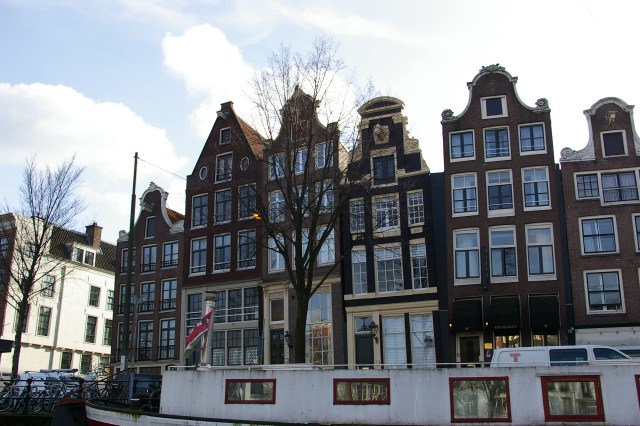
The architecture of the buildings that line the canals of Amsterdam is quite fascinating for many reasons. From the way that they lean towards the canal to allow pullies to bring the furniture to the upper floors to the very narrow buildings themselves, it is very interesting to see the different buildings along the water. Some of these homes are so small that you can touch both walls at the same time as they measure only 2 meters (about 6 feet) in width. The reason for these narrow buildings had to do with the way that the homes were taxed in the past where it was based on the number of windows and the size of the façade that faces the canal. Here are few examples, including the very narrow red home that is one of the three smallest homes in Amsterdam.
One of the Three Smallest Homes on the CanalTiny White Home on the StreetPullies to Get Furniture to the Top FloorsTiny Home with the Red and White BricksTypical Row of Homes on the Canal
With all of the different canals in Amsterdam, taking a canal cruise is a great way to see the city and learn about its architecture as well as its history. We had also taken a walking tour of the city, but touring by boat was truly enjoyable. Most tours will take you by famous sites like the Anne Frank house, but you also see various other areas of the city that you might not otherwise see.
Heading into the Bay
Narrow Canal
One of the Many Houseboats
Colorful Building with Canal Views
Heading Down a Canal
Our tour provided headsets in order to listen to the audio presentation of the tour. We learned about why the buildings lean toward the water and have hooks suspended from the roof. Because the buildings are so narrow, furniture is hoisted from the street level up to the windows in order to get them inside and the buildings lean so that the items can be raised without hitting the walls. The buildings are narrow because they are taxed based on the width of the building, so most of them are narrow and tall.
Square Houseboat Without a Motor
Bikes on the Deck of a Houseboat
Hooks to Raise the Furniture
Leaving the Bay and Heading Towards the Canals
Expensive Homes Along the Canal
People don’t just live in the buildings along the canals, but they also live in houseboats on the canals. Most of them never move and some of them don’t even have engines. There are various styles from simple and small to large and luxurious. In a city that is made up of hundreds of canals, house boats are a great way for people to live downtown and enjoy everything that city has to offer. Needless to say, in a city where bicycles outnumber residents, it isn’t uncommon to see bicycles on the decks of the houseboats. There were even some whimsical boats and a few that were half sunken, but not repaired.
Having Fun with a Sunken Boat
Another View from Our Tour
More than Just Houseboats
Fascinating Architecture
Leaning Buildings
There are many choices of canal cruise tour companies to choose from in Amsterdam and the size of the boat will determine what canals you can see and which ones you can’t. There are even small tours that offer drinks and food, which makes it more of a fun excursion rather than an actual tour. We chose a medium size tour boat for our tour, but if we ever do it again, we’d probably choose a private tour with wine and the famous Dutch cheese.
Any visit to Panama City should certainly include visiting the locks at the Panama Canal. The new locks opened in 2016 and is definitely a source of national pride for the country as this was the first project run by Panama in the canal. Although you don’t have to understand the history of the Panama Canal to appreciate how impressive the locks are from an engineering perspective. It is obviously much more than a source of pride for the country as every ship that passes through the canal pays fees that can be in the hundreds of thousands of dollars and potentially even up to a million dollars.
One of the New Locks Closing
Cargo Ships Waiting to Enter the Locks
Only the Lock Crew Can Take the Ships
The Old Locks in the Distance
The new locks are able to accommodate even larger ships as well as allow ships to get through the locks even faster, both of which means more revenue for the country. The new and old locks sit side by side and both are always in use as ships queue up to wait their turn to get through the locks. Tug boats steer them into the locks, which either raise or lower the water depending upon the direction they are going in order to allow them to continue on their journey. Depending upon the time of year, the new locks have the ability to reserve the water and reuse it for each time that the water is raised and lowered in order to keep the dam levels in Gutan Lake at an appropriate level.
View of the Locks Empty
Observation Tower with a Ship in the Locks
The Locks Before Closing
Ship Being Pulled in by Tug Boats
The original design for the canal by the French engineers was to just build a sea level canal without the use of locks. The original construction of the canal failed for a lot of reasons including yellow fever and the sheer difficulty of the task. When the US took over construction, they originally considered continuing to do a sea level canal, but eventually concluded that the locks would be a better solution. The Panama Canal was first completed in 1913, however it was overshadowed by the start of World War I. It remained an important military strategic advantage for the United States through the end of World War II.
Coastline by the Locks
The New Bridge in the Distance
Water Retention Reservoirs
A Drastic Change in the Depth of the Water
When visiting the locks, be sure to either go to the Panama Canal Museum in Casco Viejo beforehand or at least listen to the 20 minute video at the canal locks themselves. A visit to the locks will only take you about an hour, but be sure to stay long enough to at least watch one ship enter or leave the locks so that you can see them in action. We went as part of a longer tour, which is a great way to see the locks and then end up out on the canal itself. We were also treated to something special as our guide arranged it for us to walk across the old locks, which isn’t normally allowed. We weren’t allowed to stop or take pictures as we hustled across the lock. We also drove back across the locks, which is fascinating as well, but that road will not be used in the future when the new bridge is finished.