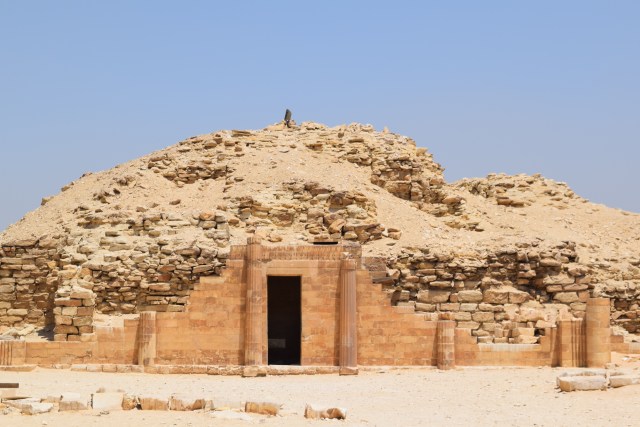
The Pyramid of Djoser, or Step Pyramid, is an ancient pyramid in the Saqqara Necropolis. It is located about an hour outside of Cairo and we toured it as part of trip to the Giza plateau. Although most people associate the pyramids of Egypt with the smooth sided Great Pyramids, step pyramids were the predecessors to such technology. There are other temples and burial grounds to be seen around the Step Pyramid, but as with Dahshur, there are not nearly as many visitors as at the Great Pyramids.
Exploring the SiteAncient WallA Crumbing TombStep Pyramid
The Step Pyramid was built around the 27th century BC and is considered the earliest large cut-stone in the world. Tourists are able to descend down the tunnel that leads to an ancient tomb, which is just an empty chamber with hieroglyphs today. It can be extremely hot, so be sure to drink plenty of water and be prepared for cramped quarters as you walk down the tunnel that has had a ramp and railings added for safety reasons.
Steep TunnelMore of the ComplexHieroglyphs in the Tomb ChamberAncient Doorway
Walking around the entire complex was very interesting and it is a shame that more people do not visit. The site was looted during the uprising in 2011, but fortunately the monuments were left relatively unharmed. For anyone who is visiting Cairo, Saqqara should definitely be one of the top sites to see during your time there.
Another View of the PyramidWeathered StatueRestorations Under WayRepair Work to Stabilize the Pyramid
There is more to visiting Cairo than just seeing the great pyramids and sailing in a felucca on the Nile River. We took a tour of Islamic Cairo that included the Mosque and Madrassa of the Sultan Hasan, which was truly fascinating not so much for what we saw, but more about what we learned from our guide. We wouldn’t recommend visiting without a guide unless you are familiar Sunni Islam, the history of Cairo , and the influences of the surrounding countries. Also, it is not currently a working mosque, so without someone to provide clarity on the features, it might not be as easily understood.
Entrance to the MosqueColorful DoorwayWalls of the Mosque
Construction of the mosque began in 1356 and was completed 3 years later, which was only due to the fact that work continued every single day from the time that construction commenced until its completion. It is one of the largest mosques in the world and also houses schools or madrassas for each of the four Sunni schools, Hanafi, Maliki, Shafi’i, and Hanbali. Our guide took us into the mosque and had us sit near the minbar, which is the pulpit where the imam would deliver the sermon. Today, of course, one can hear the prayers all over the city as they ring from the loud speakers, but before that there was a platform where the words would be repeated for those in the main courtyard of the mosque to hear.
Colorful ArtworkLooking Out from the MinbarOrnate Doorway
The mosque was built during the rule of the Mamluk’s, which were soldiers that were purchased slaves, rising their station above that of ordinary slaves. As is typical with such a type of rule, it was often cruel and would eventually lead to Egypt welcoming the Ottoman Empire to take control of the country in the late 16th century. The artwork within the mosque is as fascinating as its architecture and size. The floor of the open courtyard is a beautiful patchwork of colorful designs with an ornate dome in the center.
Minbar or Pulpit for the ImamDome in the Center SquareFloor of the Courtyard
There are many wonderful mosques in Cairo and our tour included several, but the Mosque and Madrassa of Sultan Hasan certainly stood out due to its history and architecture. It is located near the heart of the historic downtown area of Cairo and should definitely be visited while spending time in the area. Obviously going to the shops and bazaars is something that should be experienced, but if you want to understand the culture of the people and understand the evolution of the country that has been under foreign control for much of its history, you should take time to visit the mosques.
One of the DomesAnother DomeWe Sat on the Floor and Learned So Much
We enjoyed seeing a wonderful variety of pyramids during our time in Cairo, but visiting Dahshur was probably one of our most interesting experiences. First, we were virtually by ourselves as we walked around the pyramids as there were less than a dozen total other visitors there during the time that we spent there. Also, since it is the site of the first smooth sided pyramids, one successful and a couple of others that weren’t successful, it is an interesting look into the learning that occurred by the ancient Egyptians to create what would later become the Great Pyramids. Dahshur is located out in a remote area of the desert, which was purposeful as they wanted the pyramids to be away from any well-traveled area.
The Bent PyramidThe Red PyramidStairs Inside of the PyramidLooking at the Red Pyramid from the Bent Pyramid
We visited two of the pyramids, the first being what is commonly referred to as the “Bent Pyramid” as they miscalculated the dimensions of the sides and had to curve the walls as it neared the peak in order to keep it from collapsing. Although it was never used as a tomb, it is certainly still fascinating to see. Imagine all of the work that must have gone into building such a structure only to deem it a failure despite the fact that it has survived thousands of years. From the bent pyramid, you can see the ruins of another pyramid that collapsed called the Black Pyramid, which was actually built in a later time period, as well as the first actual smooth sided pyramid off in the distance. Standing in the desert and seeing the pyramid off in the distance was very surreal and it almost felt as if we were standing on the surface of Mars or some other distant planet.
Standing Outside of the Bent PyramidCrumbling Pyramid in the DistanceLooking Up at the Entrance of the Red PyramidEntrance to an Antechamber
Visiting the Red Pyramid as it is called due to the color of the stones that were used to build it, was simply amazing. Partly due to the fact that we were basically alone as we visited it, but also because we were able to climb up to the entrance and then down the steep tunnel leading to the tomb and antechambers. Although it was well worth the effort, be prepared for a steep climb up and down and the tunnel is only about 4 feet high (1 1/3 meters), so you have to crouch as you scoot your way down. The ground of the tunnel was smooth, so wooden boards with metal slats have been added to allow you to keep from sliding down the near 45 degree angle. In addition to the physical exertion, be prepared for the heat. In the desert heat, climbing into the pyramid is almost like climbing inside of a clay oven.
Tunnel Entrance to the TombBrisk Climb to the EntranceFloor of the TunnelInside of the Antechamber
Although there aren’t any colorful hieroglyphs or anything remaining inside of the tomb and antechambers, seeing the Red Pyramid in Dahshur is definitely an amazing sight. The Red and Bent Pyramids were both built by King Sneferu between 2613 and 2589 BC, which makes them almost 5000 years old. The son of King Sneferu, King Khufu, would be inspired by his father to build his own pyramid, which is now one of the Seven Wonders of the World and is known as The Great Pyramid of Giza. Obviously we would make our way to see the Great Pyramids, but seeing the pyramids of Dahshur was the perfect way to start our time in the Giza Plateau.
Steps to the PyramidLooking Up Inside of the TombErosion on the Bent PyramidTaking a Break During the Climb to the EntranceHot Desert Sand