Saints Sergius and Bacchus Church, also known as the Abu Serga Church as well as the Cavern Church, is an important historical and religious landmark in Cairo, Egypt. The church is supposed to be built on the spot where Joseph, Mary and baby Jesus rested at the end of their journey into Egypt. The church is dedicated to Sergius and Bacchus who were soldiers in the 4th century that were killed by the Roman Emperor Maximian and achieved martyrdom and sainthood.
Carving at the Entrance to the ChurchChurch AltarSome of the Many RelicsOne of the Many DisplaysCavern Where the Holy Family Stayed
The church is one of the oldest in Egypt and dates back to sometime in the 4th or 5th century. It is located near the Babylon Fortress in Cairo and it was believed that Joseph may have been one of the people to work on the construction of the fortress. We visited the Abu Serga Church as part of a tour of the section of Cairo known as Coptic Cairo where there are a variety of historical sites.
Plaque Outside of the Cavern EntranceWell Where the Family DrankBaptismalCrowds Enjoying the ChurchPainting of the Holy Family
The interior of the church is quite fascinating and contains a variety of ancient relics. It is a popular location for tourists to visit and you will find yourself in a line of people as you make your way through the actual cavern inside of the church. There is also a well within the church that is believed that the Holy Family drank from. With such historical, religious, and cultural significance, visiting the Saints Sergius and Bacchus Church is definitely worth doing while you are in Cairo.
Sign for the Sites in Coptic CairoHistoric BibleView of the ChurchAnother View of the CavernAnother Painting in the ChurchOrnate Details
If you are looking for something of a hidden gem while visiting Cairo, then we would suggest putting Bayt Al-Suhaymi on your list of places to visit. On our final day in Cairo, we made a last minute decision to book an “Islamic Cairo” tour through our hotel and we were certainly not disappointed. We saw several ancient mosques, but just as interesting was wandering the narrow streets of the Old City of Cairo. Just wandering the streets is quite exhilarating, but the highlight was taking a tour of an Ottoman era house that was built in 1648 and is in excellent condition as it was refurbished in 1997 as part of restoration project for the entire area.
The Streets of the Old City of CairoColorful Tiles and PlatesAmazing Architecture in the Old CityChandelier in Bayt Al-SuhaymiLooking Down from a WindowOne of the Rooms in the HouseStanding in the Courtyard
To enter the Old City of Cairo, you go through the Conquest Gate (Bab el Fotouh), which is one of three remaining gates through the walls of the city. As we entered, we were joined by a tourism police officer to ensure our safety in the area, although we didn’t feel that it was particularly needed. We passed by several shops and restaurants on the busy streets with many children on their way home from school. Shortly we arrived at Bayt Al-Suhaymi or House of Suhaymi in order to tour the building that is one of the first Ottoman houses built in Cairo. At the center of the house there is a courtyard called a sahn that features a small garden and some trees. Looking over the courtyard is one of the many beautiful mashrabiya windows that we saw during our tour of the Old City of Cairo.
Conquest GateOld City WallJust After Walking Through the GateShops in the Old City
Our EscortIntricate DetailShowing Its Age
We were able to walk through many of the rooms as we worked our way up through the several floors of the building. Some of the rooms had traditional furniture still inside of them and there was even a sauna in the house that has a colorful ceiling with geometric designs. The house also featured an area in the back with a mill for grinding grain. The architecture is truly what is fascinating when you visit the house. From stained glass windows, many chandeliers, and colorful tile work, it is well worth visiting.
Sitting in the HouseColorful CeilingGarden Area in the BackMillSink in the Sauna and Bathroom AreaDome Inside of the HouseDramatic Chandelier
After leaving the Bayt Al-Suhaymi, we continued on to the Sultan Qalawun Complex, which features more amazing architecture. Afterwards, we wandered through the Khan El Khalili Bazaar, which can be quite crowded as locals and tourists flock to purchase crafts and items in stalls on the narrow streets. The sights, sounds, and aromas can be overwhelming, so take your time to fully absorb everything that you see around you. There are many tours that feature going to the bazaar, but we found the historic Ottoman home to be something very special that few people get to visit.
Walking the BazaarOverwhelming SightsSo Much Architecture to SeeProtection from the SunDome in the Old CityBeautiful MosqueAnother Minuet
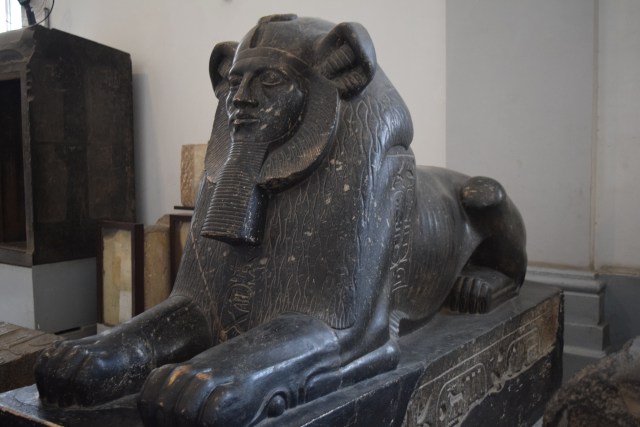
No visit to Cairo, Egypt would be complete without making time to tour the Museum of Egyptian Antiquities. As with many other sites in Egypt, having an Egyptologist as a guide is extremely helpful if you want to learn as much as possible during your time in the museum. There are so many items on display within the museum that it can be quite overwhelming. In addition to the sarcophaguses, papyrus hieroglyphs, and pieces of art, there are several dramatic statues housed within the museum.
Museum Center HallSarcophagusSphinx StatueEnormous StatuesPyramid
Obviously, much of the treasures of Egypt can be found in museums throughout the world including the British Museum and the Smithsonian Museum. Even if you have visited one of these other museums and seen the treasures, such as the golden articles found in King Tutankhamen’s tomb, it is certainly worth going to the Museum of Egyptian Antiquities in Cairo. Seeing these artifacts on display in their own country is certainly a source of national pride for Egypt. For years, they have been trying to reacquire as many of the treasures and statues as they possibly can.
Papyrus HieroglyphsBeautiful ArtworkOn the Museum GroundsElaborate CasketUnique Statue
To truly enjoy and see a majority of the museum will take you the majority of a full day. At the very least, you should plan on about four hours and that will likely be at a fairly brisk pace.
Figurines Featuring Daily LifeSo Many StatuesPapyrus ArtDetails Carved in StoneNot the Rosetta Stone