Waterfalls are always beautiful no matter where you see them, but they can be even more dramatic in the jungle. There have been a couple of occasions where we have specifically gone on excursions just to see a waterfall and we weren’t disappointed when we did. The first and one of the most dramatic was in Coroico, Bolivia, which we visited after driving down Death Road. We hiked along a trail that was lined with cocoa trees to a clearing where a large waterfall cascaded down from the cliffs above. You almost always have the opportunity to swim beneath the waterfall if you so desire. Recently, while in Panama, we followed a small stream off of the main river to another interesting waterfall. Although not quite as dramatic as the one in Bolivia, it was still a beautiful waterfall.
Waterfall at Coroico, BoliviaEnjoying the ViewPowerful Waterfall in PanamaLooking Up at the Water Flowing Down the CliffCoroico Waterfall from the DistanceHiking to the Waterfall in PanamaView from the Observation DeckPanama Waterfall from the DistanceA Perspective of It’s Height
If you are planning a trip to Panama City, one of the sites that you should consider visiting is the Metropolitan National Park. Since Panama City is surrounded by a rainforest that is protected by law, the city is literally surrounded by jungles and wildlife. You don’t have to leave the city in order to escape into nature and see some of the exotic wildlife that the country has to offer. It is about a fifteen minute drive from downtown Panama City to reach the park and the cost to enter is only $4 per person for non-Nationals ($1 for Nationals).
Views of Panama CityOne of the Many Birds in the ParkResting AgoutiStart of the Trail
Although it is located on the edge of the city and temperatures are often hot and humid, the Metropolitan National Park is still a rainforest, so you should definitely wear closed-toed shoes or hiking shoes. After stopping at the visitors center to purchase your tickets and get information on the park and the animals that live there, you will walk a short distance to the actual start of the trail system within the park. The trail in the park is basically a giant loop and if you are willing to follow it to its furthermost point, you will be rewarded with wonderful views of the city as the summit is the second highest point within the city. There are some steep sections on the trail, but overall it is considered to be moderate, but be sure to have plenty of water with you.
The Trail Takes You Above the CanopyCityscape of Panama CityTurtles on the Shore of a PondThe Trails Get Narrower
One of the first things that you see along the trail is a pond that has many turtles swimming, lazing on the shore, or propped up on twigs and sticks. They were fairly active while we were there, but obviously not the most unique of animals to see during your time in a rainforest. Another of the first animals that we saw during our time in the park was a tree sloth, although this particular sloth was just curled up and sleeping. We saw several agoutis, which are rodents that are almost a cross between a rabbit and guinea pig. It is possible to see other animals such as monkeys, deer, toucans, and parrots, but due to the number of people that visit the park, those sightings can be rare.
Turtles Coming Up for AirAnother AgoutiTypical Rainforest TreeLizard Trying to Hide
The views of the Panama City are definitely a highlight of visiting the Metropolitan National Park. As you reach the final plateau above the trail, you have 180 degree views of the city and the surrounding suburbs. It is a perfect place to sit and relax before continuing along the trail back to the start. Another common sight along the trail are the leaf-cutter ants, which traverse the trails at many different points as they carry the leaves back to their nests. You will also see many different termite mounds on the trunks of trees as well as variety of flowers, trees, and plants. If you hear some leaves rustling next to the trail, a closer inspection will likely uncover a lizard, but beware of snakes as there are many varieties in the park.
Looking Out Towards the BayLeaf-Cutter Ants Hard at WorkTermite MoundStart of the Loop
The Metropolitan National Park is a wonderful way to see a rainforest without having to leave Panama City. For a variety of reasons, we would certainly recommend having a more immersive experience in a rainforest, but visiting the park is perfect for young children or those that don’t have time to spend doing a tour or staying at an ecolodge. As Panama continues to embrace ecotourism, experiences such as these will only continue to become more accessible. We were told by one of our guides that 36% of the country of Panama is actually protected, making plenty of opportunities to enjoy nature. Although many people visit Costa Rica, a trip to Panama might just provide a more authentic and less touristic experience.
Tropical FlowerPrickly Tree TrunkThe Views are AmazingIn Case You Haven’t Seen Enough AgoutisCamouflaged Lizard
Visiting an indigenous village is always fascinating and if you go to Panama City there are tours that will take you to an Emberá village. The Emberá people are tribes that live in the Panama rainforest and still keep their traditional lifestyle. They make a living by hosting tour groups and selling their native crafts which include wood carvings, basket weaving, and jewelry. You can find these crafts being sold in Panama City, but purchasing them in the village will ensure that the money spent goes directly to the families that created them. They are very proud of their traditions and are happy to share them with the people who visit their villages.
Dugout CanoesFirst Glimpse of a VillageGreeting Us at the EntranceCeremonial MasksMusic as We Arrived
There are several different villages along the river in the rainforest, each comprised of different families. In order to reach one of the villages, we travelled in a motorized dugout canoe, which was hand carved by the villagers. On our way, we stopped to see a beautiful waterfall. We were fortunate that there were no others on the tour besides ourselves, which made it even more enjoyable. In order to reach the waterfall, we walked up through the stream, so bringing a change of shoes is advised. If you want to go swimming, you can also bring swimming suits, although we chose not to during our tour.
Women of the VillageWood CarvingsBeautiful WaterfallHappy ChildrenTraditional Dance and Music
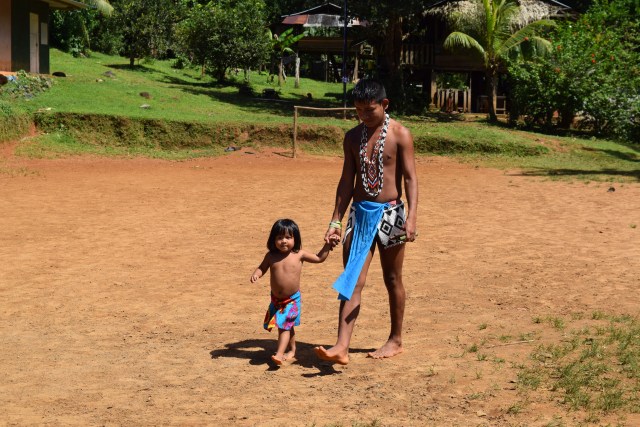
Our guide took us to one of the more remote villages, which was nice because not as many tours take the time to go there and we ended up being the only people to visit that village that day. As we beached our canoe, family members came to the village entrance and greeted us with traditional music. We then had time to wander through the village and learn more about their daily life. Their homes are simple huts with open walls and everyone sleeps on the floor. In the past, the Emberá tribe members wore nothing but small swaths of cloth around their waist, but now the women also cover up their chests as well since tourists were tending to stare at them too much.
Simplistic HutAdorable ChildWaiting for LunchSchool RoomOur Canoe
Lunch was being prepared for the entire village as well as for ourselves and while it cooked over an open fire we watched the children playing in the open area in the heart of the village. The only modern building in the village is the school, which is built by the government, and teachers arrive on weekdays to provide lessons for children up to the age of 12 to 14. Although older children will leave the village to go on to higher education, most of them return upon completion to rejoin their village or to marry into another village. It is a very simple life, but the people that live in the village seem very happy.
Cooking LunchTilapia and PlantainsHut with Crafts
Children DancingColorful Baskets and Jewelry
After eating our lunch of tilapia and plantains served in a banana leaf, the villagers gathered together to play traditional music and dances. We also had the opportunity to get a tribal tatoo, which is more like a hemp tatoo that only lasts a couple of weeks. Afterwards, we took our time to look at the crafts that were set up in a large hut with each table belonging to a separate family. For any craft that you purchase, the money goes directly to the family that created it. We were told before going to the village not to give candy or money directly to villagers other than to purchase items. If you want to give them money, it should be given to the chief, who will then be sure that it gets distributed properly.
Coming to the Shore to Say GoodbyeDancing Like a LocalGetting a TatooBirds on the ShoreMore Crafts
As we went down to our canoe to head back to our van, many of the villagers came down to the river to wish us goodbye and to cool off by swimming in the river. Once again, we were invited to join them, but chose not to go swimming. It was truly an interesting day and the Emberá tribe members were extremely friendly and welcoming. Visiting an Emberá village is certainly worth taking the time to do when spending time in Panama. It is also an excellent way to spend a little time deeper in the rainforest, enjoy the beautiful scenery, and see some of the wildlife in the area.