The Best of the Buda Castle District in Budapest, Hungary

Doing a tour, whether self-guided or with a guide, of the Buda Castle District is one of the most popular things to do when visiting Budapest, the capital of Hungary. We decided to tour the district on our own and found the history and architecture to be fascinating. There is a lot to see in the Buda Castle District, so expect to spend the majority of a day enjoying the sights. The castle district is basically the castle complex which includes the palace grounds, churches, and fortifications. Today, it is also home to many small hotels, restaurants, as well as pubs, which will give you plenty of options to grab a meal during your tour. In addition to all of the sites within the complex, castle hill on which the complex sits, also provides amazing views of the Parliament Building and St. Stephen’s Basilica. These are the important places to see when taking a tour of the Buda Castle District.

IMG_0119
Royal Palace from the Danube River Cruise
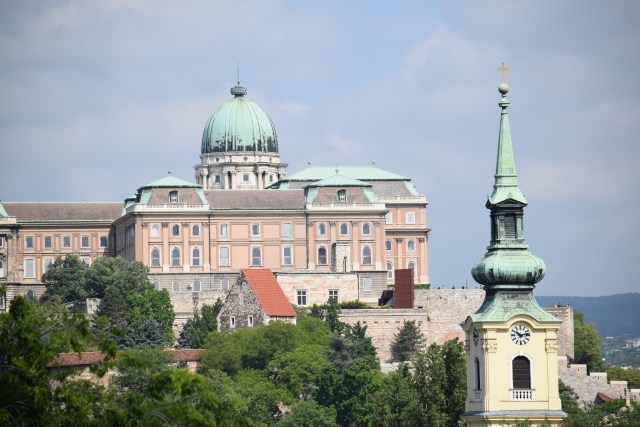
  1. The Royal Palace (Buda Castle) – Some of the best views of the palace are actually from the Danube River below, but the palace is obviously the main attraction within the complex. Unlike many other palaces that offer a glimpse into the lives of the people who lived there, the palace buildings today house the Hungarian National Gallery and the National Library.

    DSC_0012
    Matthias Church and the Holy Trinity Statue
  2. Matthias Church – With its colorful roof, Gothic architecture, and Holy Trinity Statue, Mattias Church offers a lot to see. Located in the heart of the Buda Castle District, the church’s bell tower rises high above the buildings in the complex. Like the palace, Matthias church can easily be seen from the river, but it is much more impressive up close.

    DSC_0048
    The Largest Tower of the Fisherman’s Bastion
  3. Fisherman’s Bastion – Located behind Matthias Church, Fisherman’s Bastion is made up of a fortress wall and seven towers. Built in the 1800’s, the combination of neo-Gothic and neo-Romanesque architecture make it quite interesting. Some of the best views of the Pest side of the Danube River and the Parliament Building can be seen from the walls and towers of the Fisherman’s Bastion.

    DSC_0029
    Magdaline Church Bell Tower
  4. Magdaline Church Tower – As you reach the end of the Buda Castle District, you’ll find this wonderful church tower. The Church of Mary Magdaline was originally built in the 13th century, but suffered major damage over the years. Today visitors can climb the 170 stairs to the top of the tower to enjoy panoramic views.

    IMG_0399
    One of the Many Restaurants
  5. Restaurants – Although obviously catering to the throngs of tourists who visit the Buda Castle District daily, there are wonderful choices of restaurants in the area. We actually had some of the best wine of our trip while touring the district. Whether enjoying a local dish such as Hungarian Goulash or choosing another cuisine, there are plenty of food options available.

    IMG_0356
    Riding the Funicular
  6. Funicular and Castle Stairs – The funicular is the easiest way to get to the top of Castle Hill and start your tour and also provides wonderful views along the way. We recommend taking the funicular up to the castle complex and then walking down the castle stairs when your tour is complete.

    DSC_0094
    Walking the Castle Stairs

The Buda Castle District is certainly one of the highlights to any trip to Budapest. With hundreds of years of history that extend back to beginning of Hungary’s history, it is an important cultural location. The Buda Castle District was home to Hungary’s royalty and wealthy aristocrats, which looked down upon the more humble dwellings in Pest. The Chain Bridge now extends across the Danube River at the base of Castle Hill and served to not only bridge the river, but also to blend the cities of Buda and Pest into the city of Budapest that we know today.

DSC_0458
Buda Castle District


The Royal Palace (Buda Castle) in Budapest, Hungary

On our first full day in Budapest, we crossed the Chain Bridge and took the funicular (which is a type of railway that goes up the side of a mountain) to the top of the hill in order to walk around the Castle District. The Royal Palace, also referred to as Buda Castle, is certainly one of the most dominant features in Budapest. Whether during the day or at night, when it is lit up, the palace can be seen from almost everyplace in Pest. There are definitely many wonderful things to see within the Castle District, but the Royal Palace is the most important site to visit. As we’ve mentioned before, Budapest is really two cities, Buda and Pest, that were combined when the first permanent bridge was created, so Buda Castle is the main site to visit on the Buda side of the river.

DSC_0066
The Royal Palace Dome
DSC_0458
View of the Royal Palace from the Citadel
DSC_0077
Archway to the Main Courtyard
DSC_0069
Fountain Depicting Hunters

Unlike a lot of other palaces, the inside of the Royal Palace is not a representation of what life would have been like hundreds of years ago when the aristocrats lived there that can be toured. Instead it houses both the National Gallery and the Budapest History Museum as well as the Hungarian National Library. One of the most interesting features of the Royal Palace is the fountain depicting a hunting scene that is in the main courtyard. Like many palaces, the Royal Palace is really a complex of buildings with the main residence being the main focal point. This makes for an interesting mix of architectural styles as you walk amongst the complex.

IMG_0119
Royal Palace from the Danube River Cruise
DSC_0080
Royal Crest
DSC_0087
Statue on the Palace Grounds
DSC_0427
Another View of the Palace

We decided to take the stairs along the castle wall back down to the river, which gave us wonderful views of the city. No surprisingly considering the size of the Royal Palace, many of our photographs of the palace were actually taken from across the Danube River, the top of St. Stephen’s Basilica, and even from the Citadel, which is also on the Buda side of the river. Seeing the Royal Palace lit up at night with its reflection in the water is probably one of the most iconic images of the castle and is even the main picture on the castle’s website. It is pretty much impossible not to see the Royal Palace during a visit to Budapest, but it is certainly worth taking the time to go to the Castle District and walking around the grounds.

DSC_9938
Palace Viewed from Across the River
DSC_9982
Looking Down the Funicular
DSC_0091
View of the Parliament Building from the Palace
DSC_0082
Building in the Castle Complex
DSC_0094
Stairs We Climbed Down


Our Overall Impressions of Budapest

We certainly enjoyed our week in Budapest, which included a full day trip to Bratislava in Slovakia. Although the weather didn’t always cooperate, we managed to adjust our schedules to account for the rain and definitely made the most of our time. Budapest is a beautiful city in Hungary with a lot of wonderful architecture and unique features that can be found throughout the old town areas. Sitting on the shore of the Danube River, it has been flooded and rebuilt over time, but there are many buildings that are centuries old and represent many different architectural styles. We found the historic districts to be extremely walkable, but there is an excellent public transportation system, at least within the city itself.

DSC_0315
St. Stephen’s Basilica
DSC_0257
Vajdahunyad Castle Near Heroes Square

After traveling 20 hours, including layovers, and arriving early on a Sunday morning, we got settled into our hotel and headed out to get acquainted to the area. Unfortunately, after asking the concierge for directions, we misunderstood which way to go. When we reached the main street, one of the ringed streets that circle the city and denote historical borders of the city throughout its history, we turned the wrong direction and headed away from the river and the Inner City district. Since we thought that we were heading the right direction, we were surprised to see that the buildings were not historic and beautiful, but rather very utilitarian as one would expect from a country that was occupied by the Soviet Union. When we reached the main train station, we were pretty confident that we’d gone the wrong way. We managed to find a good restaurant for lunch and then walked back towards our hotel and to our intended destination.

DSC_0427
Royal Palace in the Castle District
DSC_9984
Chain Bridge Looking Towards Pest

The city is broken up  into several districts and there are certain ones that must be on your list to see during your time in Budapest. Without a doubt the Castle District with the Royal Palace should be high on your list of places to visit. It is important to understand that Budapest is actually made up of two regions that are separated by the Danube. The side with the Castle District resides in Buda and the Parliament and Inner City are in Pest. They were distinct cities until the Chain Bridge was built and the cities were combined to make the single city of Budapest. There are important sights to see on both sides of the river, so we crossed the bridges several times during our stay.

DSC_0013
St. Michael’s Church in the Buda Castle District
DSC_0051
Parliament Building Along the Danube River

To understand the culture of Hungary, it is important to understand its history, which hasn’t always been pleasant. They have been conquered many times and also chose to side with Germany in both World Wars, which didn’t work out well for them. They also used to be one of the largest and most powerful countries in Europe and their borders and influence have been drastically reduced after the losses in the World Wars. They were also absorbed by the Soviet Union after the war, which was another tragic period in their history. There is definitely a sense of pride and optimism with their inclusion in the EU, but they don’t shy away from their history, including the role that the holocaust played within the country.

DSC_0236
Heroes Square Monument
DSC_0457
View of Buda from the Citadel

All in all, our initial impression of Budapest is that of a historic city with a complex history and culture. From the Hungarians initial migration from Asia to the Carpathian region, their ability to withstand multiple occupations, and the decisions that led them to be on the wrong side of history, there is much more to understand than just the typical palaces, castles, and cathedrals that dominate most visits to cities in Europe. In some ways, the fact that it rained a couple of days during our trip added to our impression of the city and its somewhat dark history. We look forward to providing details about each of the important sites to visit over the coming weeks.

DSC_0115
Inside the Courtyard of the Great Synagogue
DSC_0031
Historic Tower in the Castle District