Hungarian National Museum in Budapest

There are several museums in Budapest that are worth visiting and the Hungarian National Museum located near the Inner City district is certainly one of them. With three floors of exhibits, the museum focuses on the history of Hungary, which includes many different interesting periods of time. For many reasons, Hungarians are both proud of their history as well as embarrassed by certain aspects of it as well. The building, with its murals and decorative dome, is as impressive as the exhibits that it houses.

IMG_0184
Ceiling in the Museum
IMG_0212
Transylvanian Tomb
IMG_0195
Desk on Display
IMG_0192
Historic Painting
IMG_0215
Paintings of Famous Executions

We visited the museum on a rainy afternoon, making it a perfect way to get out of the rain while enjoying a trip through time as we walked through each of the floors. Hungary has a rich history and was one of the most powerful and influential countries in all of Europe for many centuries. The museum embraces that history with many displays of the royal families, battles, invasions, and more. There are a variety of paintings, statues, as well as historical garments and furniture located throughout the Hungarian National Museum.

IMG_0207
Hungarian King
IMG_0188
Painting of a Historic Battle
IMG_0186
Ancient History
IMG_0190
Garments and Other Pieces
IMG_0209
Stone Carving of a Battle

We talked to several local Hungarians during our time in Budapest and their commentary regarding the history of the 20th century were all pretty much the same. It was a time of poor choices and a period of decline and occupation until the late 1900’s when the country regained its independence. The museum does not shy away from that part of its history, but instead has displays depicting each phase of that era. It starts Hungary’s involvement in WWI, which resulted in the country being divided into small Nation-States that left Hungary itself a much smaller country than its previous size. Then in WWII, Hungary once again sides with Germany in attempt to regain its former glory, only to end up being occupied by Germany towards the end of the war. Even the liberation of Hungary by the Soviet Union turned into another occupation and a dark period in the country’s history.

IMG_0201
WWII Display
IMG_0203
Typical Living Conditions
IMG_0204
Remains of a Fallen Statue in the Museum
IMG_0200
Bitter Memories
IMG_0216
Hall in the Museum

Eventually the country regained its independence and is now once again a proud country, albeit still much smaller than it was during the previous centuries. The Hungarian National Museum is definitely quite interesting and worth at least a couple of hours to see.

IMG_0218
Many Invasions in Hungary’s History
IMG_0219
Murals on the Museum Wall
IMG_0187
Dome in the Museum Roof
IMG_0185
Decorative Ceiling
IMG_0182
Another Painting on the Museum Ceiling


Heroes’ Square in Budapest

Heroes’ Square, or Hosok tere in Hungarian, is one of the main squares in Budapest and is located next to the city park. It was created in 1896 to commemorate the 1,000th anniversary of Hungary. Sitting in the middle of the square is the Millennium Monument and the Museum of Fine Arts and the Palace of Art sit on opposite sides of the square. At the time that Heroes’ Square was created, Hungary was still part of the Austro-Hungarian Empire and some of the statues in the square today replaced those that paid tribute to the Austrian Hapsburg dynasty.

DSC_0236
Heroes’ Square
DSC_0238
Top of the Millennium Monument
DSC_0252
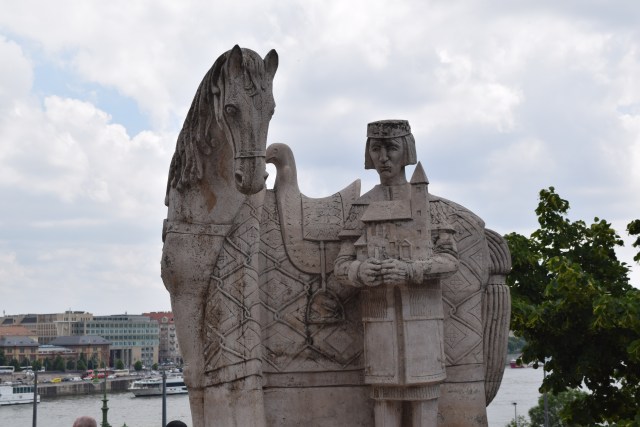
Hungarian Ruler
DSC_0244
Statues of the Seven Chieftains

We took the underground to the station that is across the street from Heroes’ Square, which is the easiest way to get to the square and city park from downtown. On the day that we visited the square, there was a demonstration going on advocating for peace. The colorful flags surrounding the tomb-like Memorial Stone, which is not an actual tomb, but meant as a tribute to all of those who died protecting Hungary over its 1,000 year history.

DSC_0233
Demonstration
DSC_0241
Memorial that Looks Like a Tomb
DSC_0250
One of the Many Statues
DSC_0249
Statue Between the Columns

There are a series of statues on either side of the Millennium Monument. On top of the columns on the left is a male statue that represents a symbol of war and on the of the columns on the right is a female statue representing peace. In between each of the columns are statues of historic figures in Hungarians history along with a mural below their statue meant to represent their major accomplishment. In addition to the columns with their statues, the base of the monument also has statues depicting the seven chieftains of the tribes who originally founded Hungary.

DSC_0246
Representing War
DSC_0247
Representing Peace
DSC_0257
Vajdahunyad Castle Near Heroes Square
DSC_0259
Paddle Boats

Visiting Heroes’ Square is definitely fascinating on its own, but we would highly recommend that you combine it with a tour of the city park. The weather wasn’t quite warm enough on the day that we were there, but there are paddle boats that can be rented to go out onto the lake. There is also the Vajdahunyad Castle and the Budapest Zoo are also located in the park. It is also just a nice place to spend a couple of hours walking the paths and enjoying the scenery. Depending upon how much you decide to see while there, you can easily spend an entire day at the park.

The Cave Church in Budapest, Hungary

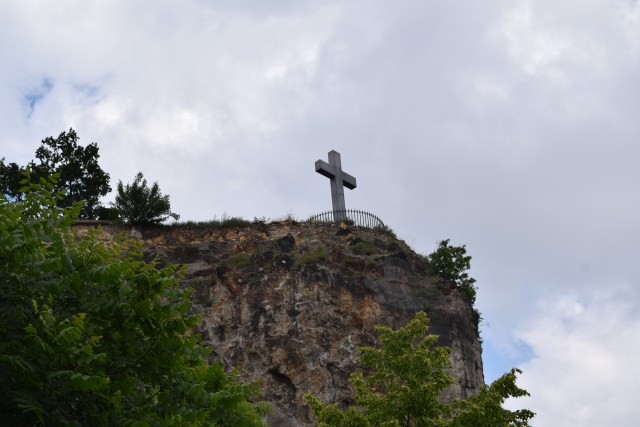
Located at the base of Gellert Hill, the hill that the Citadella (fortress) sits atop, is a system of caves. One of the caves was converted into a chapel in the 1920’s and even served as a hospital for the Germans during WWII. Known as the Cave Church, it was certainly one of the most interesting places that we visited during our time in Budapest. A cross on top of the hill denotes the location of the church, which is also located near the famous Gellert Baths where people gather to enjoy the therapeutic thermal baths.

DSC_0500
Altar Within Cave Church
IMG_0975
Seating for Religious Ceremonies
DSC_0480
Cross On Top of Gellert Hill
DSC_0506
Church Exterior Outside of the Cave
IMG_0983
Historic Artifacts
IMG_0992
Courtyard in the Church Exterior
DSC_0489
Intimidating Shadow

The atmosphere within Cave Church is interesting due to the lack of natural light and the rugged cavern walls. After its conversion to a hospital by the NAZI army during the war, it returned to serving as a church until 1951 when the Soviet Union had it shut down. The chapel was raided by the Soviet Army, the monks arrested, and the cave sealed up until Budapest regained their freedom in 1989. Today, the monks of the Pauline Order continue to operate the church and hold religious functions on the site as well as maintain it as a tourist attraction.

IMG_0974
Walking into Cave Church from the Entrance
DSC_0496
Hungarian Artwork
DSC_0502
More Art in the Cave
DSC_0485
Statue Outside of the Church
IMG_0988
Museum Display
IMG_0976
Flowers in Remembrance
DSC_0490
Main Altar

There is a nominal fee in order to enter the church and walking through the cavern will take you about thirty minutes to fully explore. In addition to the statues and artwork inside of Cave Church itself, there is also a small museum with additional historic artifacts. Exploring the church and understanding its history is certainly worth the effort of walking along the Danube below Gellert Hill. We combined it with our visit to the Citadella, which sits high above. It may not be the most well-known site in Budapest, but if your itinerary allows, we would recommend visiting.

DSC_0497
Ornate Confessional
DSC_0491
Statue Lit Up Against the Cave Wall
DSC_0486
Stained Glass Inside of the Cave
DSC_0498
Wood Carving in the Museum
DSC_0495
Painting in the Museum
DSC_0487
Wooden Statue Embedded into the Cave Wall