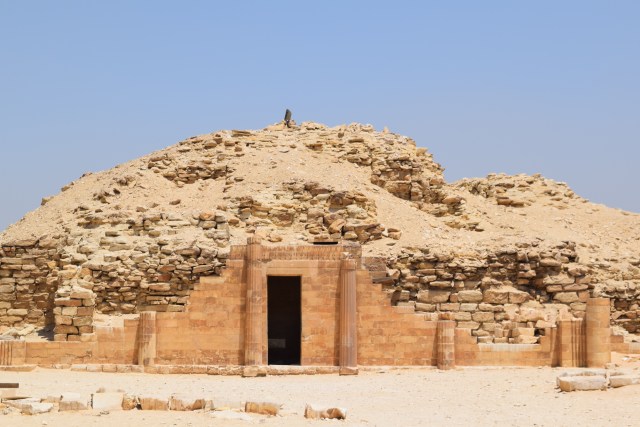
The Pyramid of Djoser, or Step Pyramid, is an ancient pyramid in the Saqqara Necropolis. It is located about an hour outside of Cairo and we toured it as part of trip to the Giza plateau. Although most people associate the pyramids of Egypt with the smooth sided Great Pyramids, step pyramids were the predecessors to such technology. There are other temples and burial grounds to be seen around the Step Pyramid, but as with Dahshur, there are not nearly as many visitors as at the Great Pyramids.
Exploring the SiteAncient WallA Crumbing TombStep Pyramid
The Step Pyramid was built around the 27th century BC and is considered the earliest large cut-stone in the world. Tourists are able to descend down the tunnel that leads to an ancient tomb, which is just an empty chamber with hieroglyphs today. It can be extremely hot, so be sure to drink plenty of water and be prepared for cramped quarters as you walk down the tunnel that has had a ramp and railings added for safety reasons.
Steep TunnelMore of the ComplexHieroglyphs in the Tomb ChamberAncient Doorway
Walking around the entire complex was very interesting and it is a shame that more people do not visit. The site was looted during the uprising in 2011, but fortunately the monuments were left relatively unharmed. For anyone who is visiting Cairo, Saqqara should definitely be one of the top sites to see during your time there.
Another View of the PyramidWeathered StatueRestorations Under WayRepair Work to Stabilize the Pyramid
No visit to Cairo in Egypt would be complete without going to see the Great Pyramids. Although the Pyramid of Khufu is officially known as The Great Pyramid, the entire complex is often referred to as the Great Pyramids of Giza. The Pyramid of Khufu is the oldest of the Seven Wonders of the World and also one of the most intact wonders and stands 481 feet tall (146.5 meters). There are actually six pyramids that make up the pyramid complex as well as the Great Sphinx. The Pyramid of Khafre still has the limestone covering at the top of the pyramid that would have covered all of the pyramids making their sides completely smooth as opposed to the exposed stones that are visible today.
The Great SphinxPyramid of KhafreLooking Up at the Great PyramidView of the Giza Plateau with Cairo in the Background
The three large pyramids are certainly the focal point of the complex, but there are other interesting features of the site including pits where the remains of a ship were buried. It is important to understand that to the ancient Egyptians, because the sky was blue and water was blue, they believed that they needed to sail to the afterworld. It was an important connection to the Nile, which they relied on for there survival, and the world of the gods. The three smaller pyramids were for queens of the Pharaohs which serve as a reminder that the Egyptians had a high regard for women of royalty. Clearly, the Great Sphinx is also an important sight to see while spending time on the Giza plateau.
One of the Queen PyramidsOne of the Pits Where the Ship was UnearthedOne of the Many CamelsBusy Road Between the Sphinx and the Great Pyramid
Because of its close proximity to Cairo, the pyramid complex is extremely busy with tourists, horse drawn carriages, camels, and people peddling trinkets. It is worth having a guide with you so that you can learn the historical facts regarding the pyramids, but it is a location that you can visit on your own. Riding a camel in the desert with the pyramids in the background is about as touristy as it gets, but is worth doing for that classic photo opportunity. Although fascinating, it only takes a couple of hours to fully see the Great Pyramids and the surrounding sights.
Yes, We Rode the CamelsThe Great Pyramid Up Close, People in the Foreground Providing ScaleFace of the Great SphinxThe Giza Plateau
Clearly, seeing one of the Seven Wonders of the World is an incredible experience. Gazing up at the pyramids, seeing not only their height, but also the symmetry of their architecture has to make you marvel at the ingenuity of the people who built them over 4,500 years ago. In fact, the Great Pyramid was the largest man-made structure for over 3,800 years, truly an impressive feat.
Walking Around the Great Pyramid with the Pyramid of Khafre in the BackgroundThe Great SphinxThe Great PyramidWalking Among the Pyramids
Located about 30 miles outside the town of Alamosa in Colorado, the Great Sand Dunes are a fascinating feature that has been created by nature over thousands of years. The giant sand dunes sitting at the base of the Sangre de Cristo Mountains highlight the diversity of habitats in southwestern Colorado, which ranges from wetlands, prairies, mountains, and forests. The sand dunes seem oddly out of place, it is almost as if a piece of the Middle East was scooped up and dropped in the mountain valley. The reality is that they were created after a large lake dried up thousands of years ago and the wind drove the sand to the base of the mountains.
Sand Dunes and Mountain PeaksThe People Give Perspective to the Size of the DunesThe Size can be DeceivingHiking the Sand Dunes
Although this year the mountains did not receive a lot of snow and therefore the runoff was minimal, usually there is a river or stream running at the base of the sand dunes, making the contrast even more interesting. One of the good things about the stream not being there was that we didn’t have to get our feet wet in order to get to the base of the dunes, but the bad part was that it was even more sand to walk through in the heat of the sun. It is not easy walking in the sand and even harder walking up the steep sides of the dunes. They may not seem as large from the distance, but the actual peaks of the dunes can be as high as 750 feet (230 meters).
First View of the DunesA SandboarderPeople at the PeakAt the Base of the Sand Dunes
As more and more people visit the dunes, one of the most popular things to do is to bring a sandboard and go sandboarding. People will spend hours climbing to the top and then boarding their way back down. Just to reach the top is difficult, so to do it over and over again in order to shred the sand is a real achievement. It also means that you will be surrounded by plenty of crowds as people flock to the area. There is camping nearby and you will find and endless array of motorhomes and RV’s. Since it is a national park, you can expect to pay $20 per vehicle to get into the park, which is good for seven days.
Walking to the DunesLike Walking on a Strange PlanetPrairie, Dunes, and Mountains
It took us about three hours to drive from Colorado Springs to the Great Sand Dunes, but it is well worth the drive. We hadn’t been to the sand dunes for over twenty years, so it was also a little bit nostalgic for us as we remembered bringing our young children there to play in the sand. We only spent a couple of hours at the sand dunes as climbing the hills is very exhausting and hard on the legs. Even though we were walking in the Sahara Desert only a few weeks ago, visiting this unique place in Colorado was really something special.
The Struggle to Reach the SummitA Sense of ScaleLooking Away from the Dunes