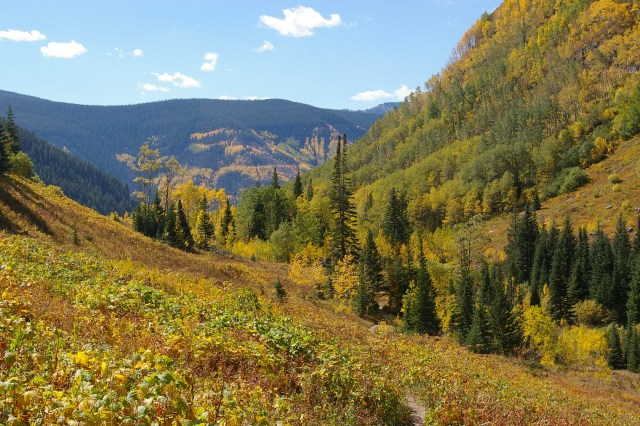
Tips for Hiking in the Colorado Mountains

IMGP2570
Hiking in Autumn

One of the things that we enjoy about living in Colorado is our access to a wide variety of trails to go hiking. Especially during the summer when the wildflowers are blooming and getting into the mountains can be a great escape from the heat of the Front Range. We will often see tourist from out of the state on the trails and often they are not prepared for hiking in the altitude on what can be sometimes some rough terrain. People in Colorado will often refer to those people who come from states that don’t have mountains and are closer to sea level as “flatlanders”. Here are some tips for anyone who plans to go hiking in the Rocky Mountains.

  • Stay hydrated – Colorado actually has a very dry climate and when you combine that with the altitude, it is very easy to get dehydrated. We normally recommend to people visiting the state that they do a combination of water and sports drinks so that they can stay hydrated and replace electrolytes. At a minimum, you should have a water bottle with you when you are hiking, but if you are going to hike for more than an hour, you should probably consider investing in a CamelBak that has a large water pouch so that you know you’ll have enough water.
IMGP4212
Wearing Our CamelBak
  • Know your limitations – Get information on the trail that you are going to hike before you go. You can get information from local stores that sell hiking equipment or use an app like All Trails to get information. Trail ratings are usually Easy, Moderate, or Hard, but be aware that if you are doing a trail with any kind of elevation gain, even a moderate trail can be quite difficult. There are some trails where you have scramble over boulders or walk next to steep cliffs, so inexperienced hikers can get injured or worse if they push themselves beyond their limits. And it is important to understand that sometimes going down is more difficult that going up, so keep that in mind while you are hiking.
IMGP3431
Scrambling Over Rocks
  • Wear and carry sunscreen as well as bug spray – Even at the base of the mountains, you are usually at 6,000 feet (1,800 meters) and then the elevation increases as you hike. That means that you are closer to the sun, which means that even on an overcast day, there is the risk of getting sunburn. Also, there are ticks in the forests and a lot of trails go near streams, waterfalls, or end at lakes and reservoirs, which means that there can be mosquitos. Colorado doesn’t have a lot of bugs, but you should be prepared.
IMGP3555
Tranquil Pond at the Top of the Mountain
  • Carry a first-aid kit, compass, and small flashlight – Mishaps can happen and you want to have at least some wipes and Band-Aids in case someone gets some scrapes and bruises. There have been plenty of times where the trails are not as well marked as one might expect and it is possible to lose your way off of the trail if you are not careful. Many people rely on their smart phones for a flashlight and compass, but if something happens to your phone it is better to have the real thing. Also, you are likely not to have cell service in the mountains, so a compass app won’t be able to find your location. If you are going on a shorter hike, the flashlight and compass are not necessarily needed, but you should always have the first-aid kit.
DSC01152
An Easy to Follow Trail
  • Wear appropriate footwear – You don’t have to buy hiking boots or shoes, but you need to at least wear shoes with soles that grip. Almost any trail is going to have loose stones and gravel that can be slippery to walk on and you will likely be walking on larger rocks and tree stumps. Nothing will ruin your hike quicker than slipping and falling on the trail. It is also important to wear shoes that are comfortable and have been broken in so that you don’t end up with blisters. We don’t recommend open toed shoes of any kind for hiking, even if they have good gripping soles. Snakes, prickly bushes, and other obstacles could easily get to your feet.
DSC01121
Hiking Up Pikes Peak
  • Pay attention to the weather – Storms can come quickly in the mountains and often you won’t see the clouds building due to the peaks that are surrounding you. Colorado gets more lightening strikes than most other states and your proximity to the clouds that produce them makes them even more dangerous. It doesn’t have to be raining for lightening to occur, so always be alert to any changing weather conditions. Even when the forecast doesn’t indicate storms, the weather in Colorado can be unpredictable and forecasts are often wrong.
DSC_0753
Clouds Building on Previously Sunny Day
  • Be alert for wildlife – Seeing animals when you are hiking can be a wonderful experience, but only if you see them before they see you. There are bears, elk, moose, deer, wild turkeys, and many other animals in the mountains of Colorado. When you are in bear country, it is wise to make noise while you are hiking or hike on trails that are hiked by a greater number of hikers. However, just because other people are on the trail ahead of you, don’t assume that means that you won’t see wildlife, their routes often take them across the trails and it could just be that they get there between groups of hikers.
DSC01203
Mule Deer next to Trail
  • Take breaks and look around – First of all, you are likely to get winded easily, so it is important not to over exert yourself. Secondly, the views from most trails are wonderful, whether seeing valleys, other mountain peaks, or just the beauty of an Aspen grove, there is much to see. You can often find yourself staring down at your feet, trying not to trip on the rocks that are on the trail, and missing the wonderful sights that are all around you. You went on a hike to get into nature, be sure not to miss seeing it.
IMGP5089
Incredible Views

Hiking is one of the most pleasurable experiences where you truly get to enjoy nature at its finest. With a little precaution, you can ensure that your hiking experience will be one that you will treasure forever. With so many trails in Colorado to choose from, pick the one that is right for you and take advantage of seeing some of the beauty that this wonderful state has to offer.

How to Make a Memorable Trip to Cochabamba, Bolivia

Traveling to the city of Cochabamba in Bolivia provides you with many different opportunities to explore the heart of this fascinating country. There are many different sites that should be seen when visiting Cochabamba, so planning in advance is worth the effort. We truly enjoyed our time there and we hired a guide to take us to see some of the locations that are outside of the city. Getting around in Bolivia is not always easy as the roads are often in a constant state of repair and the heavy rains often create landslides that take out portions of the roads. Although you don’t have to do everything on this list to enjoy your time in Cochabamba, we’d certainly recommend at least getting out and doing at least one that is not located in the city itself.

Standing in the Temple Ruins
  1. The Ruins of Incallatja – One of the tours that took while we were in Cochabamba, Bolivia, was to the ruins at Incallajta. They are some of the most well-preserved ruins in Bolivia and it really gives you a sense of how great the Incan civilization was. Sadly, not a lot is known for sure about the site and it seems that it is not often visited by tourists. The main temple building is massive and is probably an indication as to how important the site was to the Incan empire. In addition to being a ceremonial site, it was also the easternmost defensive fortification for the Inca, with a large wall to protect them from the rival tribes in the Amazon.

  2. Entrance to Polacio Portales
  3. Polacio Portales – We would definitely recommend taking a tour of the Palacio Portales. Not only is the building architecturally interesting, but the gardens, which were modeled after those at Versailles, are quite beautiful as well. Built by the wealthy millionaire Simon Patino, the palace was completed in 1927. Patino’s fortune was built by owning the majority of the tin industry in Bolivia, which earned the nicknames of “The Tin Baron” and “The Andean Rockefeller”. At one point, he was considered to be one of the five wealthiest people in the world.

  4. Just Before Our First Hike in the Amazon Jungle
  5. Carrasco National Park – One of the most interesting places that we visited during our time in Bolivia was to the Carrasco National Park. It is in the Amazon Rainforest and is most famous for having a cave with Guacharo birds. These birds are virtually blind and are nocturnal feeders that eat the fruit of the oil palm trees. They are also known as “blind birds” or “oil birds” because of their unique eating habits as they are the only nocturnal fruit eating birds in the world that fly. Needless to say, there are a lot of other animals that can be found in the park and hiking through the park provides a variety of unique experiences. In addition to hiking in the park, we also stayed in an ecolodge as well as ziplined through the canopy.

  6. Steps Leading Up to Cristo de la Concordia
  7. Cristo de la Concordia – One of the first things that we did upon our arrival in Cochabamba was to visit the Cristo de la Concordia, which is a statue of Jesus Christ. The statue sits on top of San Pedro Hill and is accessible by a cable car or you can walk the 2,000 steps to the statue if you prefer. The statue is quite interesting, but since San Pedro Hill is almost 900 feet (265 meters) above the city of Cochabamba, the views are worth the visit as well.

  8. High Altitude Trekking
  9. Pico Tunari – Although we didn’t do this hike during our visit, our guide Remy shared the information with us and it would definitely be on our list when we visit again. Hiking to the summit of Pico Tunari, the highest point in Cochabamba, is certainly something that will provide striking views of the area. Bolivia has one of the most stable mountain outdoor weather in the world, making it a great place for mountain trekking.

Parrots Outside of Our Hotel

Visiting Cochabamba provides the opportunity to see so many amazing places. Just walking around the city is wonderful, the people are extremely friendly, and the food is quite delicious. We stayed at a very nice hotel during our visit and enjoyed waking up to several families of parrots in the trees on the grounds. From Cochabamba, we traveled to La Paz, the capital of Bolivia, to continue our exploration of the country.

10 Things to Do Prior to Traveling Internationally that Some People Forget – Updated

Planning a trip is a fun process as you investigate where to stay, what to see, and make travel arrangements. However, if you are traveling internationally, there are several things that you should be sure to do in addition to the actual planning of the trip itself. Some of these things need to be done several weeks in advance, so be sure to consider them as part of your planning process. They are simple steps that could help you avoid your trip of a lifetime from turning into the disaster of a lifetime. We originally wrote this article in 2018, but the information is as pertinent today as it was then, if not more so. (This article contains a couple of affiliate links and, if you purchase, we may receive a small commission)

imgp2184
Amsterdam from the Roof of Our Hotel
  1. Check Visa and Passport Requirements – Be sure to see whether the country you are visiting requires a tourist visa in order to enter and how long the visa will be valid. Also, be sure to know whether there are limitations as to how many entries are allowed using the visa (something we learned the hard way when we went to Vietnam). There are usually requirements as to how many blank pages you need to have in your passport as well as how much longer than the dates of your travel that the passport will be valid for as well. Although some countries allow you to get your visa at the airport upon your arrival, we recommend that you get your visa in advance to avoid any delays. We have heard of people being stuck for days trying to bet their visa due to a variety of issues. Also, be aware that to get some visas, you will need to send your original passport, so you’ll need to coordinate getting the visa around any other travel you might be doing. We use iVisa when planning our trips.
DSC_6402
Cairo, Egypt
  • Register Your Trip with Your Embassy – There are a couple of reasons for registering your trip (in the US, you can register with Safe Traveler Enrollment Program, STEP). Usually you will receive alerts for the country that you are visiting, such as protests, violence, or other issues in specific cities or regions. Another reason is that if something bad should happen and your family at home has concerns, information about your trip is registered in order to allow officials to start an investigation.
  • IMGP2950
    Chennai, India
  • Confirm what Vaccinations and Immunizations are Required – Especially in the world post-Covid, there are many different requirements regarding proof of a negative test and there will likely be requirements for a proof of a vaccination in the near future. Depending upon where you are traveling, there are often required and recommended vaccines and immunizations. Some of these can be expensive and need to be done weeks before travel, so be sure to contact your doctor once you have checked the list. Also, some countries require proof of the vaccinations and in those cases you will want to have the official form. Also, if taking any prescription medicine with you, be sure to carry them in there original containers with the prescription labels otherwise you might have your medicine confiscated. In some cases, you may need a letter from your doctor stating what you are taking and why you are taking it as proof that you are not smuggling in pharmaceuticals. 
  • DSC_4136
    Canopy of the Amazon Rainforest
  • Contact Your Bank and Credit Card Issuers – We always recommend that you don’t carry a lot of cash with you when you travel and that you take money out of an ATM upon your arrival. You need to contact your banks and credit card companies prior to your trip so that they can note your account to avoid any transactions being rejected as fraudulent. Be sure to include any countries where you have layovers as well as you might want to grab a bite to eat or buy something during the time that you have as you wait for the next leg of the trip to begin. Also, be sure to find out if there are any daily withdrawal or spending limits on your accounts or foreign transaction fees. It is important to note that even though you report your trip with the bank, there is no guarantee that it won’t still be marked as fraudulent, so you should keep the number of the fraud department with you, which is separate from customer support and is usually available 24/7. Although we don’t recommend taking a lot of cash, we do recommend that you take a small amount, about enough for a taxi and food, and convert it into local currency if possible.
  • IMG_1051
    Our First Glimpse of Greece
  • Take Photos of Your Travel Documents and Email Them to Yourself – It is always a good idea to take photos of your travel documents and take them with you, but you should email them to yourself as well. If something happens and everything is stolen from you, having the ability to go to a computer and access your email will give you the ability to print out new copies to take to the local embassy. In addition to your travel documents, passport and visas, also make a list of all of the international numbers for your banks and credit cards. If your wallet is stolen and you need to contact your banks, having those numbers available will make it much easier to get replacements and keep fraudulent charges from occurring.
  • IMGP6938
    Sunrise over Lake Thingvallavatn in Iceland
  • Buy Travel Insurance – There are a variety of ways to get travel insurance and, in general, we always recommend having it. Be sure to look at what types of things are covered as not all plans are the same. Some will cover the costs of cancelled transportation, some will pay for transportation in the event of a natural disaster, and others will provide medical insurance, including evacuation services. Clearly, the location and type of travel that you are doing will help you determine the extent of coverage that you need, but having at least minimal insurance is good for the peace of mind that it provides. We have heard so many stories from people where having travel insurance turned out to be a true savior and other stories from people who didn’t get travel insurance and it turned out disastrous. We have all learned from Covid that circumstances can change in an instant and money spent can’t always be recouped if you are not insured. A couple of excellent resources are Visitor’s Coverage and World Nomads.
  • DSC_3680
    View of the Quilotoa Caldera and Lagoon in Ecuador
  • Check Travel Warnings and Advisories for the Region – Similar to registering your trip, you should check out travel warnings for the country that you are visiting. We would also recommend checking the advisories and warnings for neighboring countries as well. In certain cases, you might discover that not only are there warnings, but there can also be restrictions on travel to certain parts of the country. Knowing this information in advance will help you with your planning so that you don’t put a location on your itinerary that might put you and your companions at risk.
  • IMGP9432
    Looking Down at Part of Death Road in Bolivia
  • Check for the Local Public and Government Holidays – You may do some of this as part of your normal planning process if you are looking for a celebration or festival, but it is good to know if the places you want to visit might be closed. It might also affect transportation schedules and your ability to see government run sites. Additionally, depending on the country that you are visiting, some holidays are regional and not national, so be sure to pay close attention to that as well.
  • IMGP3959
    Snake Charmer in Morocco
  • Provide Your Trip Details and Hotel Information to Family and Friends – In case something were to happen to your cell phone, having a way for people to get messages to you is important. Also, if there are issues with your transportation, the people who care about you can check to see if there is a reason that they potentially haven’t heard from you. They may never use the information, but they will appreciate your sharing the information with them just in case.
  • IMG_1588
    The Coast of Southern California
  • Check What Currencies the Country Accepts and the Conversion Rates – Some countries will accept multiple types of money and that might avoid the need for converting money when you arrive. Some countries even prefer money from other countries other than their own due to issues with their government and inflation. The opposite can also be true, they may accept money from other countries, but might frown upon having to convert it to use locally. You need to understand the current conversion rates and there are apps and web sites that will provide you that information. As you walk into a store or restaurant, it is important to know what you are really spending when you make a purchase. We typically use an app on our phone and then round up for the conversion rate. For example, if the conversion 1 local dollar is 7.3 US dollars, we will calculate it as 8 US dollars when we see a price. That way we know that what we spend will possibly be less than we thought, but that is better than finding out it was more than you had budgeted.
  • IMGP1781
    Saint Nicholas Church Tower in Brasov, Romania

    None of these suggestions will guarantee that you have a wonderful time on your next trip, but they just might be your savior if things don’t go as expected. We follow all of these whenever we travel internationally and consider them to be just as important as planning the highlights of our trip.