Széchenyi Chain Bridge in Budapest, Hungary

The first permanent bridge across the Danube river in Hungary is the Széchenyi Chain Bridge, often just referred to as the Chain Bridge. It was built in 1849 and connects the cities of Buda and Pest, allowing the cities to join to become the capital of Hungary. It is credited as having changed Hungary by increasing it’s prosperity and cultural influence. The bridge connects the Széchenyi Square on the Pest side of the Danube with the Clark Adam Square on the Buda side and is a pedestrian bridge in addition to motorized traffic.

DSC_9977
View from the Széchenyi Chain Bridge Towards the Citadella and Elizabeth Bridge
DSC_9969
Lion Guarding the Bridge
DSC_9984
View of the Bridge from Castle Hill
IMG_0339
Walking Across

We crossed the Széchenyi Chain Bridge from the Pest district in order to go to Castle Hill in the Buda district. The funicular, or cable car, that takes you to the top of Castle Hill is located near the bridge, making it an easy way to walk from the old town of Pest to see the sights within the Castle District. The entrance to the bridge features sculptures of lions carved out of stone, which are quite impressive. The bridge was destroyed in 1945 by the Germans as they retreated, but the towers survived and the bridge was rebuilt and reopened in 1949.

DSC_9972
One of the Bridge Towers
DSC_9953
Buda Castle
DSC_9921
View of Széchenyi Chain Bridge from Elizabeth Bridge
IMG_0333
Lion and Bridge Tower as We Crossed

The views from the bridge are quite stunning including views of the Danube River, the Parliament Building, Elizabeth Bridge, the Citadella, and Buda Castle. The Széchenyi Chain Bridge is definitely one of the most visible landmarks in Budapest as it can be seen from all of the scenic overviews located on both sides of the river. When visiting Budapest, it is certainly worth taking the time to stroll across the bridge and enjoy the sights from either direction.

DSC_9955
Bridge with Castle District in the Background
DSC_0460
View of the Bridge from the Citadella (Fortress)
DSC_0058
Cityscape Behind the Bridge
IMG_0338
Inscription on the Lion Statue


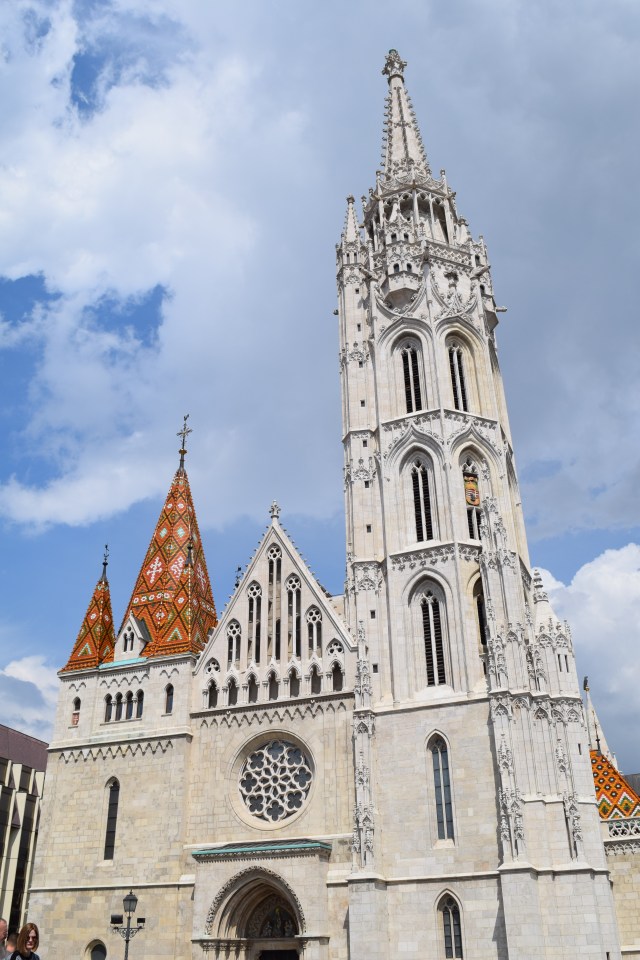
Colorful Church Roofs

Most of the cathedrals and churches have very colorful stained glass windows and ornate features, but the roofs themselves are fairly plain. In some cases, though, the roofs themselves are works of art. Both St. Stephen’s Cathedral in Vienna, Austria and Matthias Church in Budapest, Hungary are excellent examples of that. They both have very colorful roofs with geometric designs that draw your eyes to them. It certainly makes for an interesting contrast to the stone walls of the churches themselves.

dsc_1220
Close Up View of the Roof of St. Stephen’s Cathedral in Vienna
DSC_0044
Back of the Matthias Church
DSC_1195
View of the Cathedral and It’s Roof
DSC_0018
Matthias Church
DSC_1221
Looking Down from St. Stephen’s Cathedral
DSC_0305
Matthias Church in the Castle District from the Top of the Basilica


Hungarian National Museum in Budapest

There are several museums in Budapest that are worth visiting and the Hungarian National Museum located near the Inner City district is certainly one of them. With three floors of exhibits, the museum focuses on the history of Hungary, which includes many different interesting periods of time. For many reasons, Hungarians are both proud of their history as well as embarrassed by certain aspects of it as well. The building, with its murals and decorative dome, is as impressive as the exhibits that it houses.

IMG_0184
Ceiling in the Museum
IMG_0212
Transylvanian Tomb
IMG_0195
Desk on Display
IMG_0192
Historic Painting
IMG_0215
Paintings of Famous Executions

We visited the museum on a rainy afternoon, making it a perfect way to get out of the rain while enjoying a trip through time as we walked through each of the floors. Hungary has a rich history and was one of the most powerful and influential countries in all of Europe for many centuries. The museum embraces that history with many displays of the royal families, battles, invasions, and more. There are a variety of paintings, statues, as well as historical garments and furniture located throughout the Hungarian National Museum.

IMG_0207
Hungarian King
IMG_0188
Painting of a Historic Battle
IMG_0186
Ancient History
IMG_0190
Garments and Other Pieces
IMG_0209
Stone Carving of a Battle

We talked to several local Hungarians during our time in Budapest and their commentary regarding the history of the 20th century were all pretty much the same. It was a time of poor choices and a period of decline and occupation until the late 1900’s when the country regained its independence. The museum does not shy away from that part of its history, but instead has displays depicting each phase of that era. It starts Hungary’s involvement in WWI, which resulted in the country being divided into small Nation-States that left Hungary itself a much smaller country than its previous size. Then in WWII, Hungary once again sides with Germany in attempt to regain its former glory, only to end up being occupied by Germany towards the end of the war. Even the liberation of Hungary by the Soviet Union turned into another occupation and a dark period in the country’s history.

IMG_0201
WWII Display
IMG_0203
Typical Living Conditions
IMG_0204
Remains of a Fallen Statue in the Museum
IMG_0200
Bitter Memories
IMG_0216
Hall in the Museum

Eventually the country regained its independence and is now once again a proud country, albeit still much smaller than it was during the previous centuries. The Hungarian National Museum is definitely quite interesting and worth at least a couple of hours to see.

IMG_0218
Many Invasions in Hungary’s History
IMG_0219
Murals on the Museum Wall
IMG_0187
Dome in the Museum Roof
IMG_0185
Decorative Ceiling
IMG_0182
Another Painting on the Museum Ceiling